

We went to see Bruce Goff: Material Worlds at the Art Institute of Chicago, and what struck me most wasn’t the architecture, it was his mind. Goff didn’t simply design buildings. Much like Frank Lloyd Wright, Goff seemed to generate entire atmospheres.
The exhibition makes clear that beyond his “wild” architecture, Goff was also a painter and composer, deeply interested in modern music. As you move through the galleries, some of his player-piano compositions fill the space. The music is syncopated, slightly jazzy, a little Philip Glass before Philip Glass.
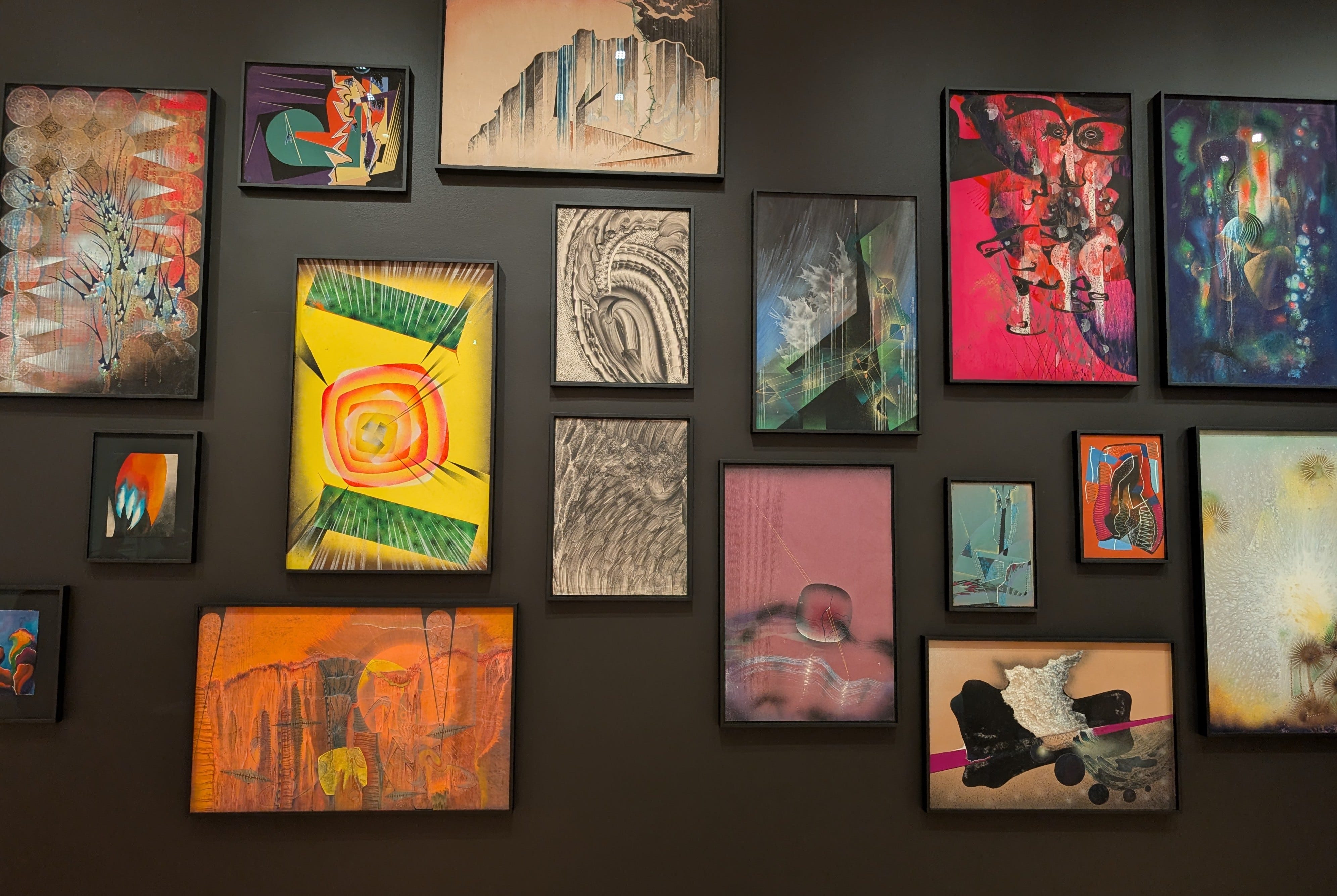
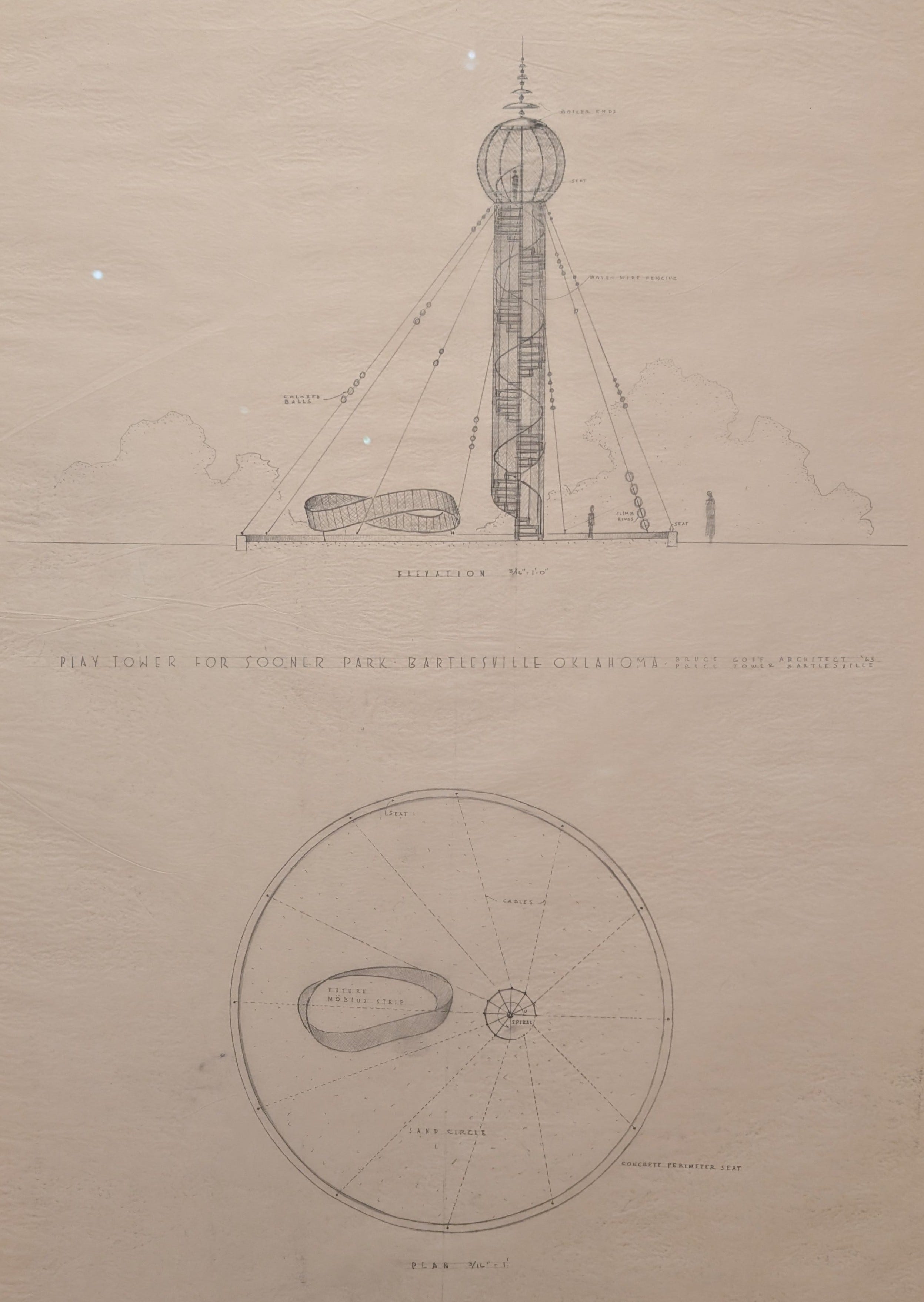
It becomes impossible to separate the buildings from the sound from the drawings. Everything feels like it came from the same internal weather system. And some of the drawings are extraordinary. His rendering for the unbuilt Summer Park Play Tower (below) feels uncannily like Hilma af Klint: mystical, symbolic, almost cosmological.
Wall text notes his influences, including Gustav Klimt, which becomes obvious once you see his ornamental screen (below) layered with patterning.
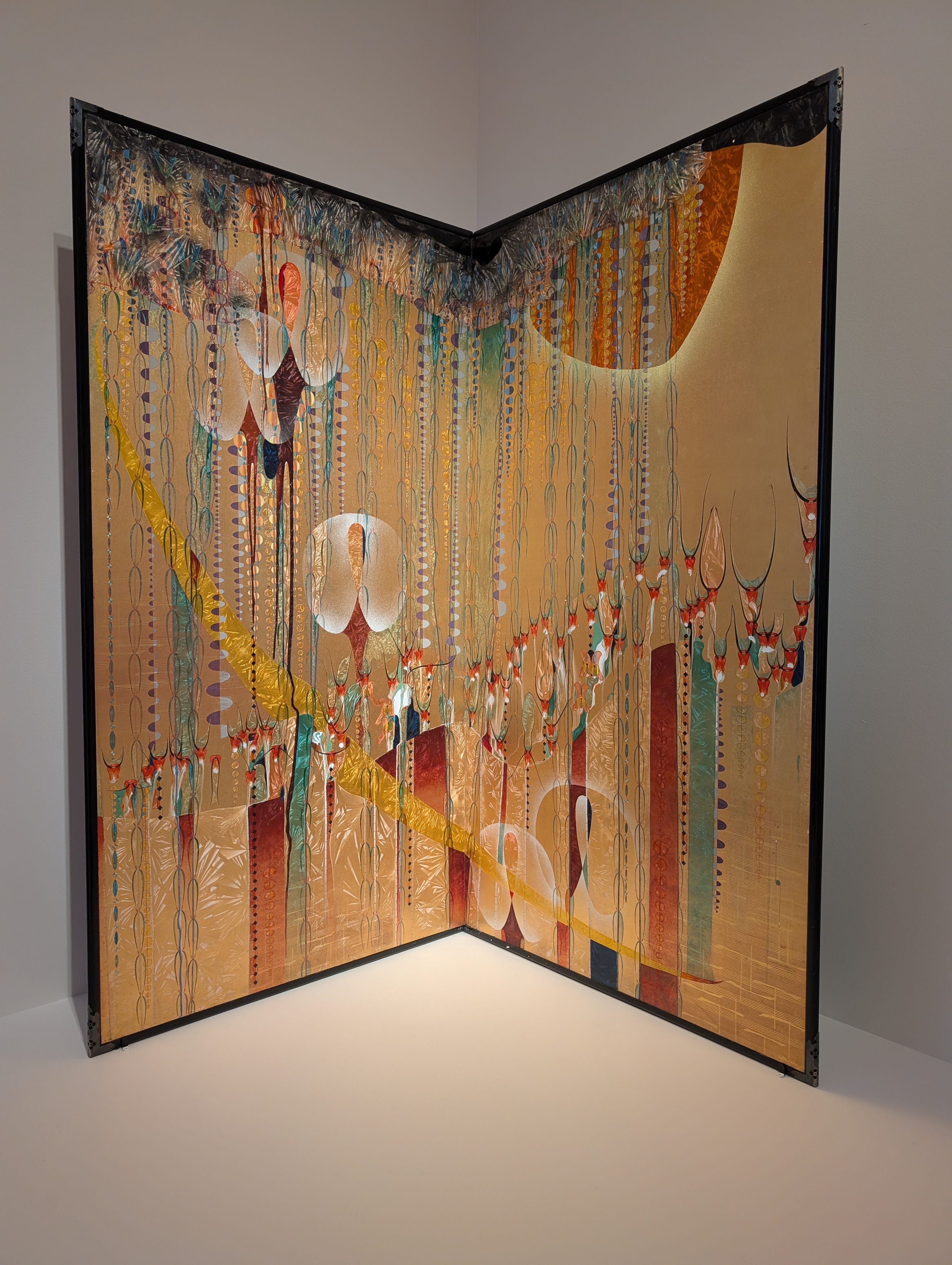
These aren’t merely architectural documents. They stand on their own as works of art. Even his mimeograph poems feel designed.
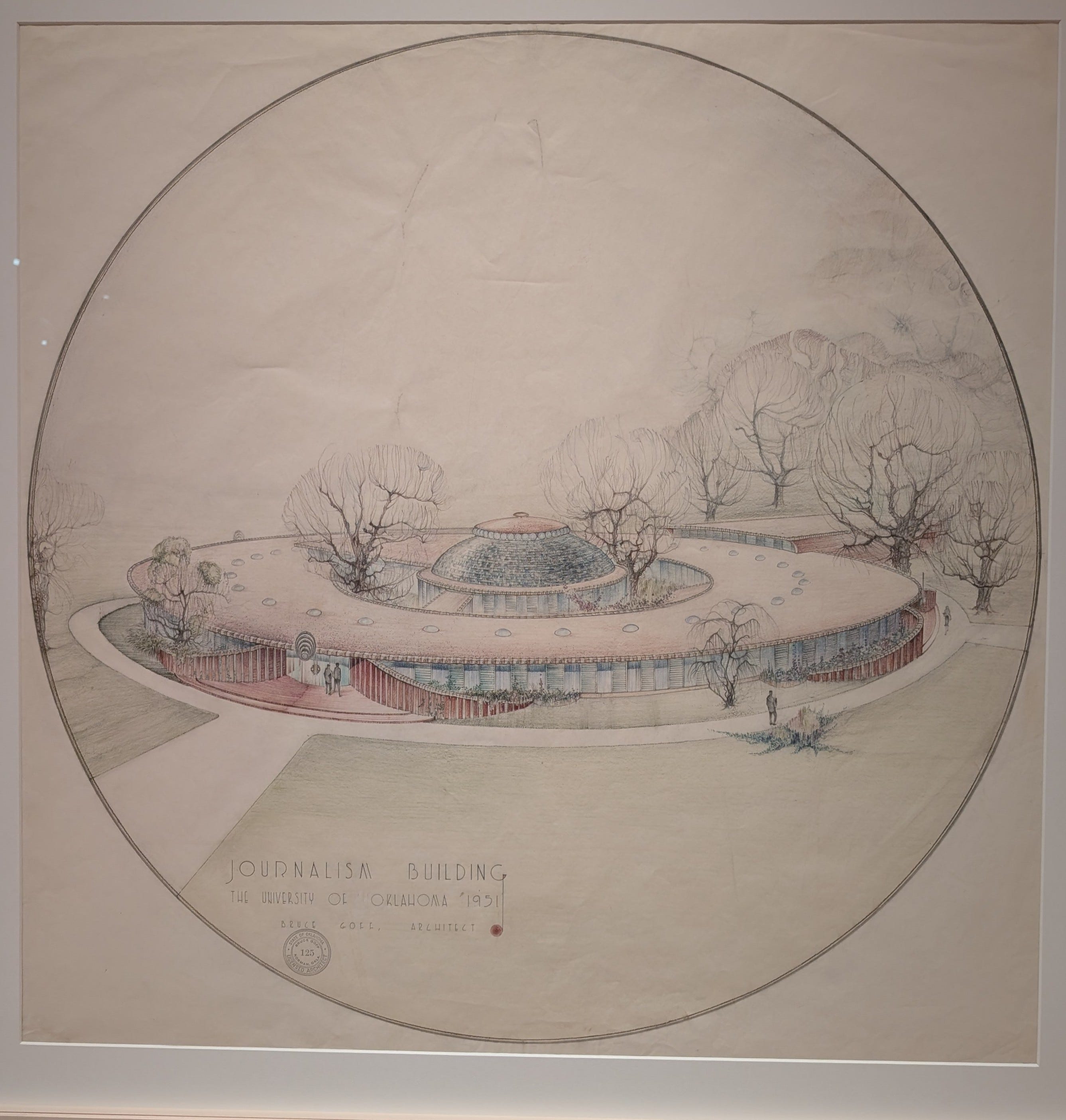
Many of the drawings of unrealized projects give a serious Jetsons’ vibe. A 1951 drawing for a journalism building (below) looks like a spaceship. The insistence on roundness intensifies that otherworldly feeling.
The Circle Apartments drawing continues that rocket-like futurist trajectory. A 1961 drawing for the unbuilt Viva Hotel in Las Vegas anticipates a kind of anthropomorphic, almost cartoonish architecture.


And then there are the houses. Some are deeply atmospheric, like the perspective drawing of the Charlotte Gutman house in Gulfport, Mississippi. A pencil rendering (below) that is so evocative it feels cinematic.
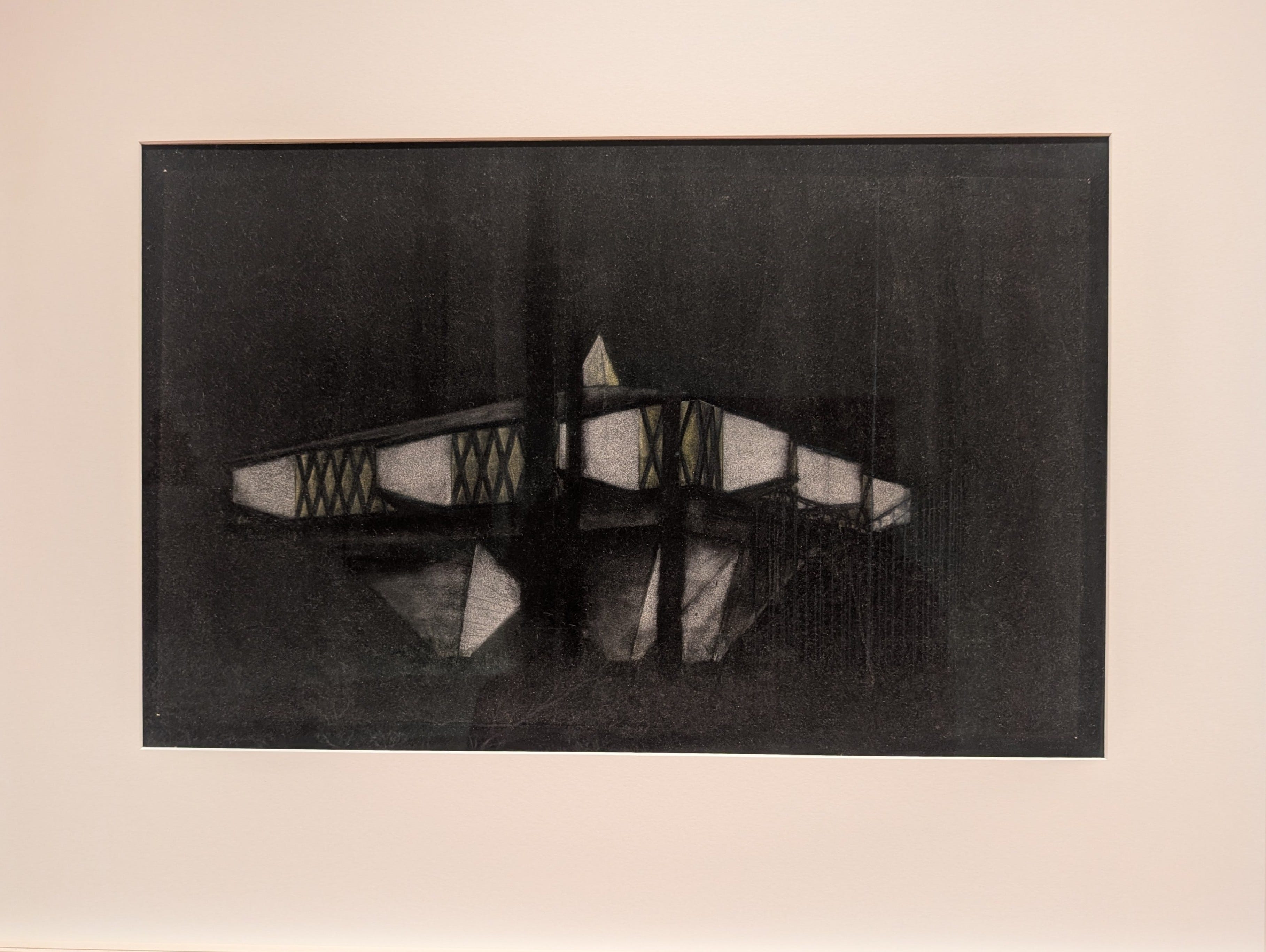
Others verge into something else. There’s the turkey farmers’ house, with a roof made of orange outdoor carpeting and plastic turkey inseminators used as decorative elements. That’s not an exaggeration. It’s an object lesson in creative freedom without an internal governor.
Which brings me to the most interesting tension in the show. Part of the issue with some of his later designs is that Goff had so many ideas in his head that he couldn’t edit them into a more distilled form. The buildings get busier. Weirder. Less resolved. Usually far less successful.
He is a case study in imagination versus restraint.
And then there’s the Boston Avenue Church.
Early into the exhibit we had a moment of recognition. Bruce Goff designed the Boston Avenue Methodist Church in Tulsa, OK. When we were in Tulsa in 2018, I remember looking up the architect because the limestone building was such an Art Deco masterpiece, but I did not recall his name, until we saw the drawings.
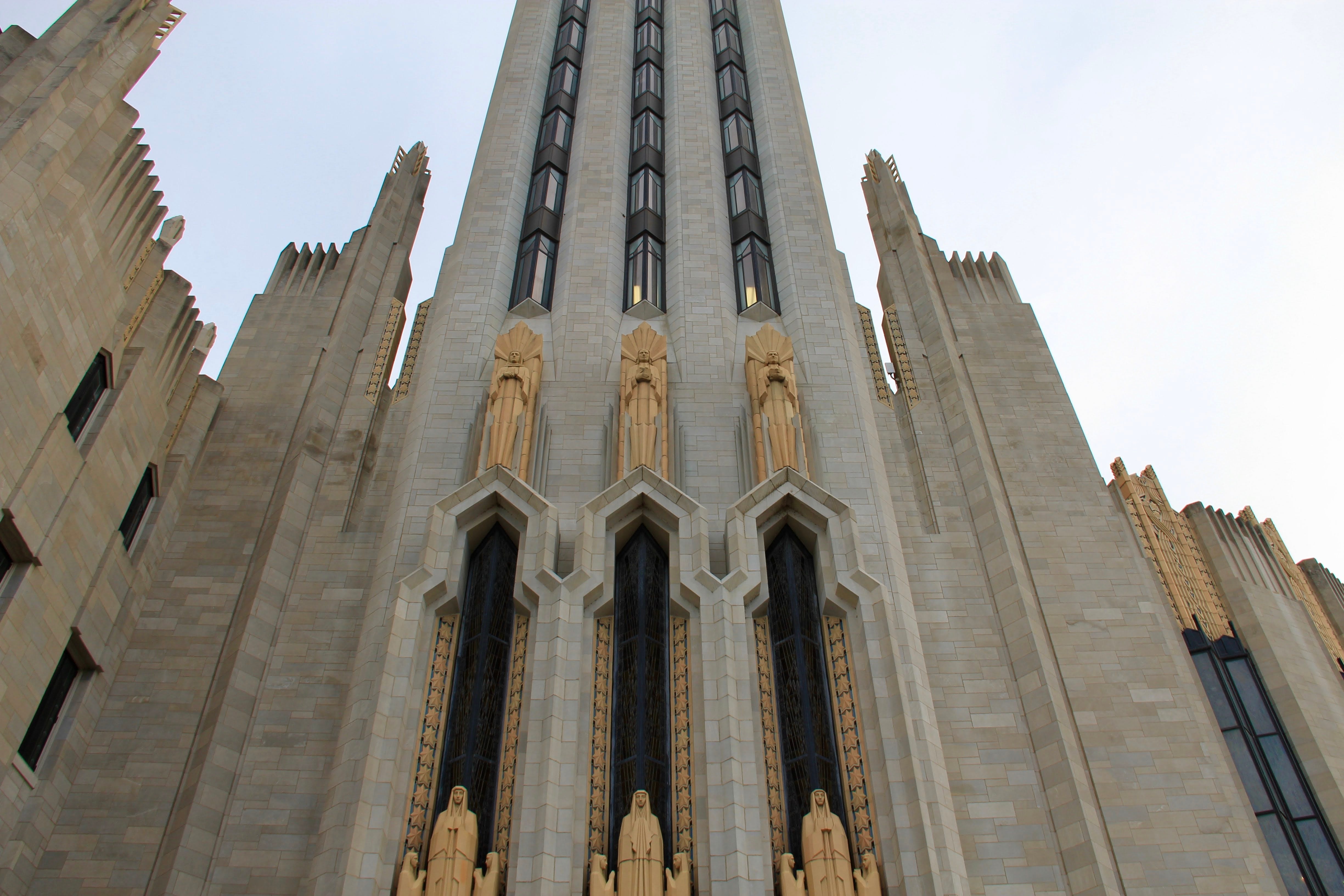
Goff’s first drawings of the church were made in his early 20s, and he was 25 when the church opened its doors. In my opinion, it is one of the most perfect Art Deco buildings. Monumental and graceful. Fluidly vertical. Perfectly stylized.


Boston Avenue feels like the moment when Goff’s imagination and discipline were perfectly balanced.
Even in later drawings, like his 1957 TeleMovie building (unbuilt) you can still see the Art Deco vernacular peeking through: swooping curves, dramatic open space, a certain sculptural sweep.
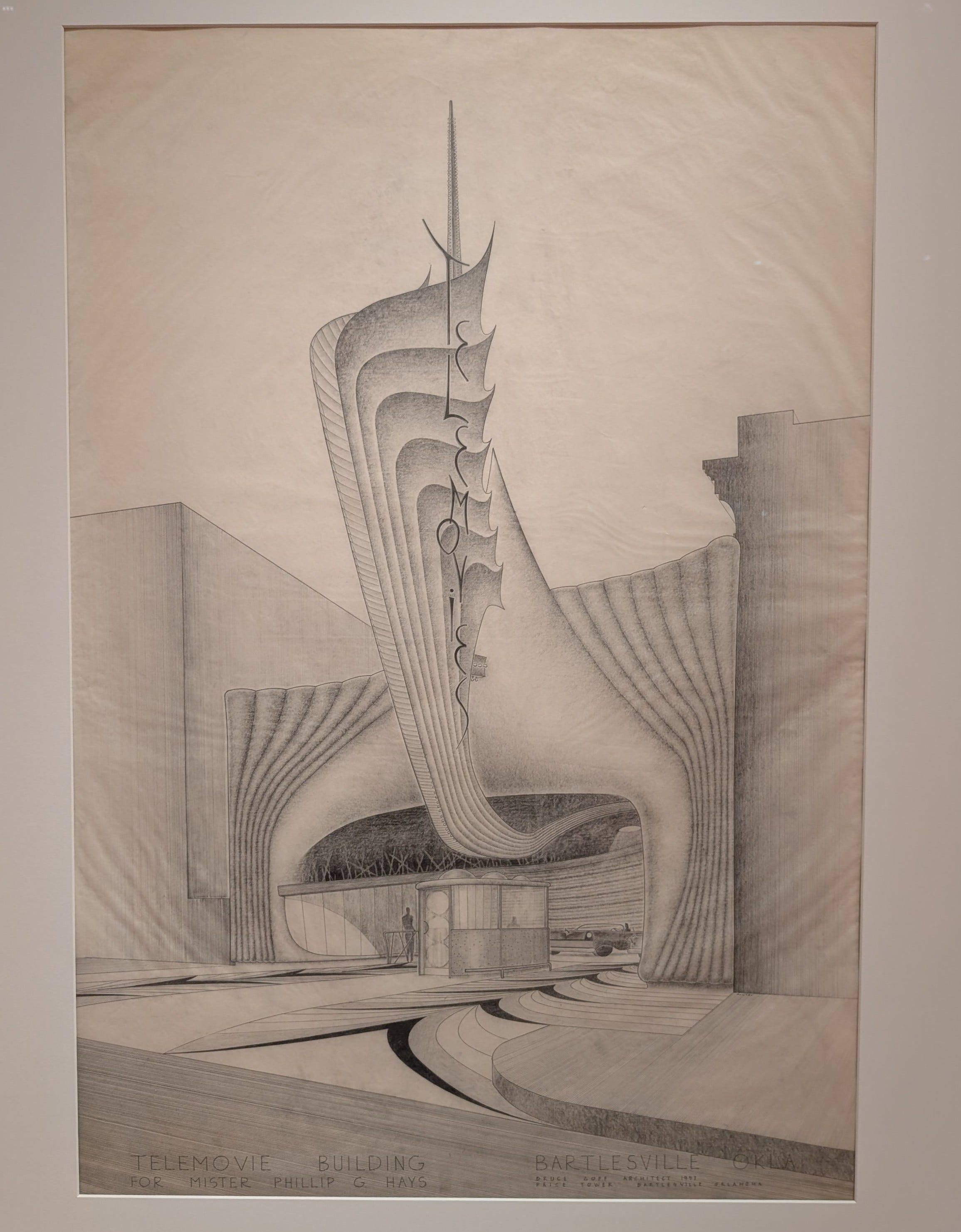
Despite being the biggest fan-girl of Boston Avenue Church, not every Goff building “works,” particularly as he got older. Some are goofy. Some feel overthought. Some feel like the product of a brilliant mind unwilling, or unable, to edit itself.
But there is something compelling about an architect who treated every medium — architecture, painting, music, poetry — as part of one continuous artistic practice. Goff reminds us that modernism wasn’t a single clean line. It wasn’t all Mies and restraint. There was also mysticism. Excess. Orbs. Space. Jazz. Turkey farmers with orange carpet roofs.
And occasionally, limestone perfection on a Tulsa street corner.
A Note About the Gallery Itself
It would be disingenuous to not acknowledge something I’ve seen circulating online: claims that the Art Institute of Chicago reconfigured or replaced its African art galleries in order to stage this exhibition. I have not independently verified the specifics of the curatorial decisions or long-term gallery planning, and the museum’s public materials frame Material Worlds as a temporary exhibition within their rotating exhibition spaces. If there is more to understand about the gallery reconfiguration, it deserves transparency and context from the institution.